Atlas is being developed as a multi-industry business intelligence platform. The local prototype uses fictional data to validate workflows before commercial pilots.
INSIDE THE LOCAL PROTOTYPE
A management review in three views.
These images come from prototype checks using fictional data. Select an image to inspect the original interface detail.
Where does the CEO start?
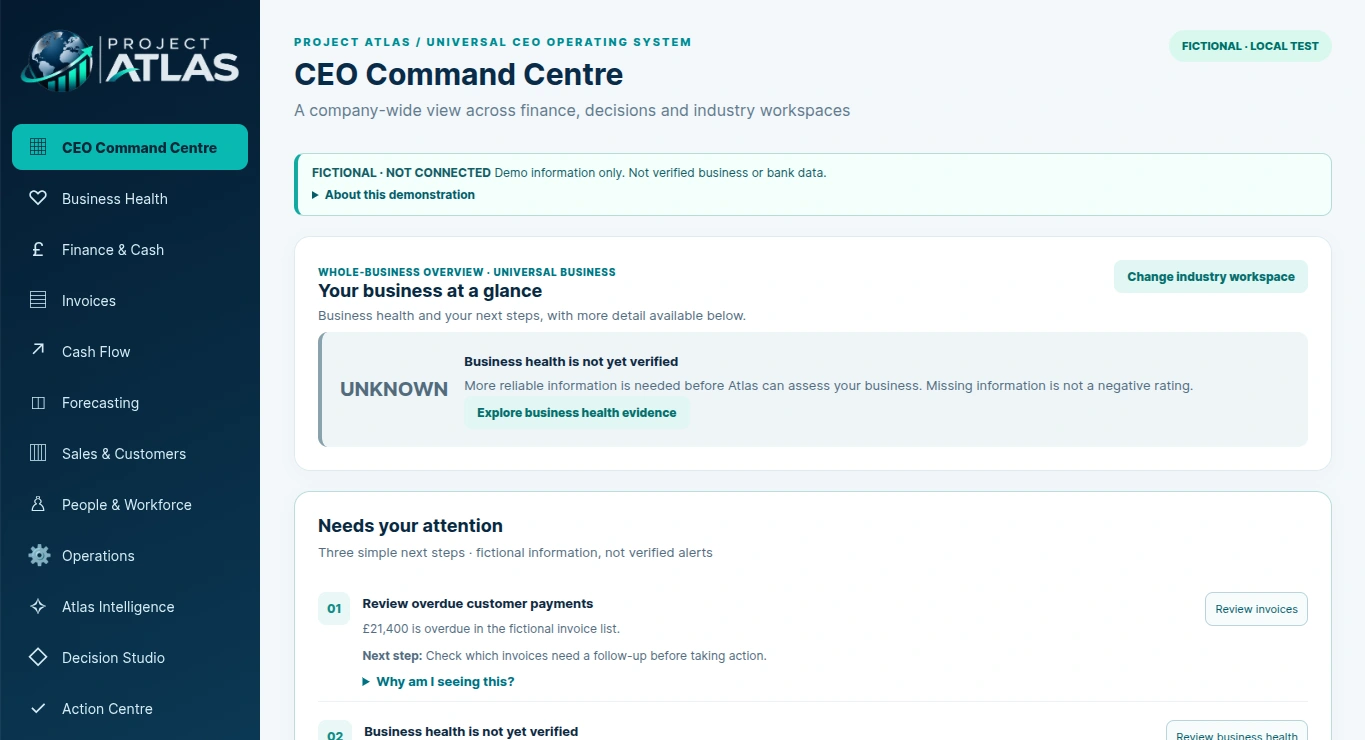
The Command Centre brings the overall health assessment and the next review items together. In this scenario the health state is unknown because the evidence is incomplete. That gives the owner a reason to investigate before relying on a rating.
What needs follow-up?
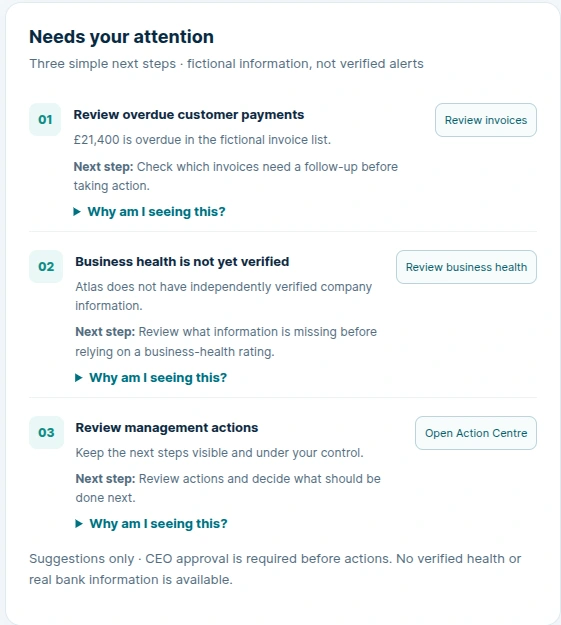
The attention panel identifies overdue customer payments, explains the information still needed for a health assessment and links the owner to the Action Centre. A finance manager can review which invoices need a conversation before the next cash review.
What goes into the management meeting?
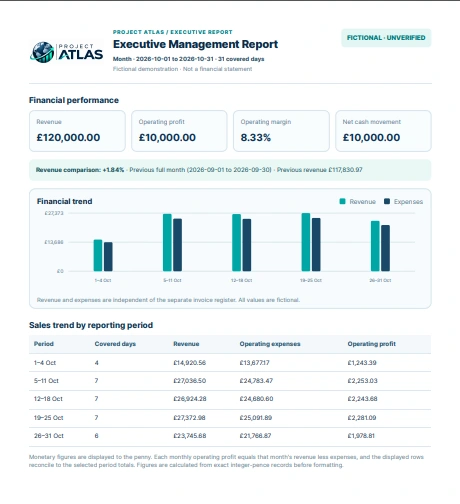
The executive report combines revenue, operating profit, margin and cash movement with a period-by-period breakdown. A manager can use the print view to discuss the same figures with colleagues.
PRODUCT EXPLORER
Follow a decision through Atlas.
Project AtlasInteractive example · fictional data
£84,200
Monthly sales rose 8%. Higher revenue alone does not explain how much cash the operator can use this week.
£32,400
Cash is forecast to tighten as supplier payments fall due. The owner can ask finance to review payment dates and expected receipts.
3 open
Review supplier payment dates, confirm overdue receipts and agree a cash buffer before the next weekly review.
Supplier payments
Outstanding receipts
Weekly cash buffer
CAPABILITIES
Inside the platform.
Executive overview and business health
Review overall health and category-level indicators. Green, amber, red and unknown states help an owner decide which area deserves attention and where more information is needed.
Cash flow and forecasts
Historical sales show what happened. A forecast helps the team consider what may happen next. Weekly, monthly, quarterly and annual views support different planning conversations.
Decision Action Centre
Turn a concern into a follow-up. A finance manager might review overdue receipts, while an operator checks supplier commitments before the next weekly meeting.
Roles and reporting
The prototype distinguishes owner, finance manager and analyst responsibilities. Reports are intended to support a clear management conversation with more detail available when needed.
Integrations and AI roadmap
Accounting integrations, including QuickBooks as a candidate, payment-delay prediction and AI recommendations are planned workstreams. Their timing depends on validation and integration testing.
DECISION LAB
What changes when a payment arrives late?
Try the customer payment scenarios. Each shows how the same business can finish the week with a different cash position.
Illustrative scenario · fictional figures
Friday cash position
Opening cash
£24,000
Customer receipt
+£12,000
Payroll and supplier bills
−£29,000
Closing cash£7,000
Scheduled payments are covered. Check the remaining buffer against next week’s commitments.
Help shape a future pilot
We are interested in hearing from hospitality operators who run a regular performance review. Tell us how many sites you oversee, which reports you use and one decision that takes too long. These conversations will help define a future pilot and its success criteria.
Identify one decision the business regularly makes and agree how it is handled today. A useful baseline could include the time taken to assemble the report, the people involved and the point at which a follow-up is usually assigned. This would make it possible to compare the workflow over successive reviews.
During the review
Ask an owner to locate the issue without coaching. Then ask a finance contact to explain the period, source figures and limitations behind it. If two people interpret the same indicator differently, record where the explanation broke down. Those observations are valuable product evidence even when the calculation itself is correct.
After the review
Return to the decision at the next meeting. Was a person responsible for the action? Was the outcome recorded? Did the information arrive early enough to affect what the team did? These questions help separate the usefulness of an attractive dashboard from the usefulness of a recurring operating workflow.
Reading the management report
Begin with the reporting period
Check the start date, end date and number of days covered before comparing two figures. A partial month can make sales appear to fall when the reporting period simply contains fewer trading days. A finance reviewer should be able to explain which dates contributed to a figure and whether comparable information is available for the previous period.
Separate earnings from cash timing
A profitable order can create a cash gap if the customer pays after the supplier bill falls due. Read the cash movement alongside the profit figures and identify the dates of the largest expected payments. An owner can then ask whether the pressure reflects trading performance, payment terms or the timing of a single large receipt.
Close the review with an owner and a date
A useful action records who will check the issue, what evidence they need and when the team will review the outcome. For an overdue receipt, the next step might be confirming the customer's payment date. At the next review, the manager can compare the expected date with the actual receipt and decide whether the forecast needs updating.